
The consequential problem
Climate Adaptation & Resilience · Low-Carbon Construction
Bamblock
Rethinking the building block for a lower-carbon world.
Bamblock asks whether we can redesign one of construction's most fundamental components to support adaptable, lower-carbon and easier-to-build housing.
Our approach
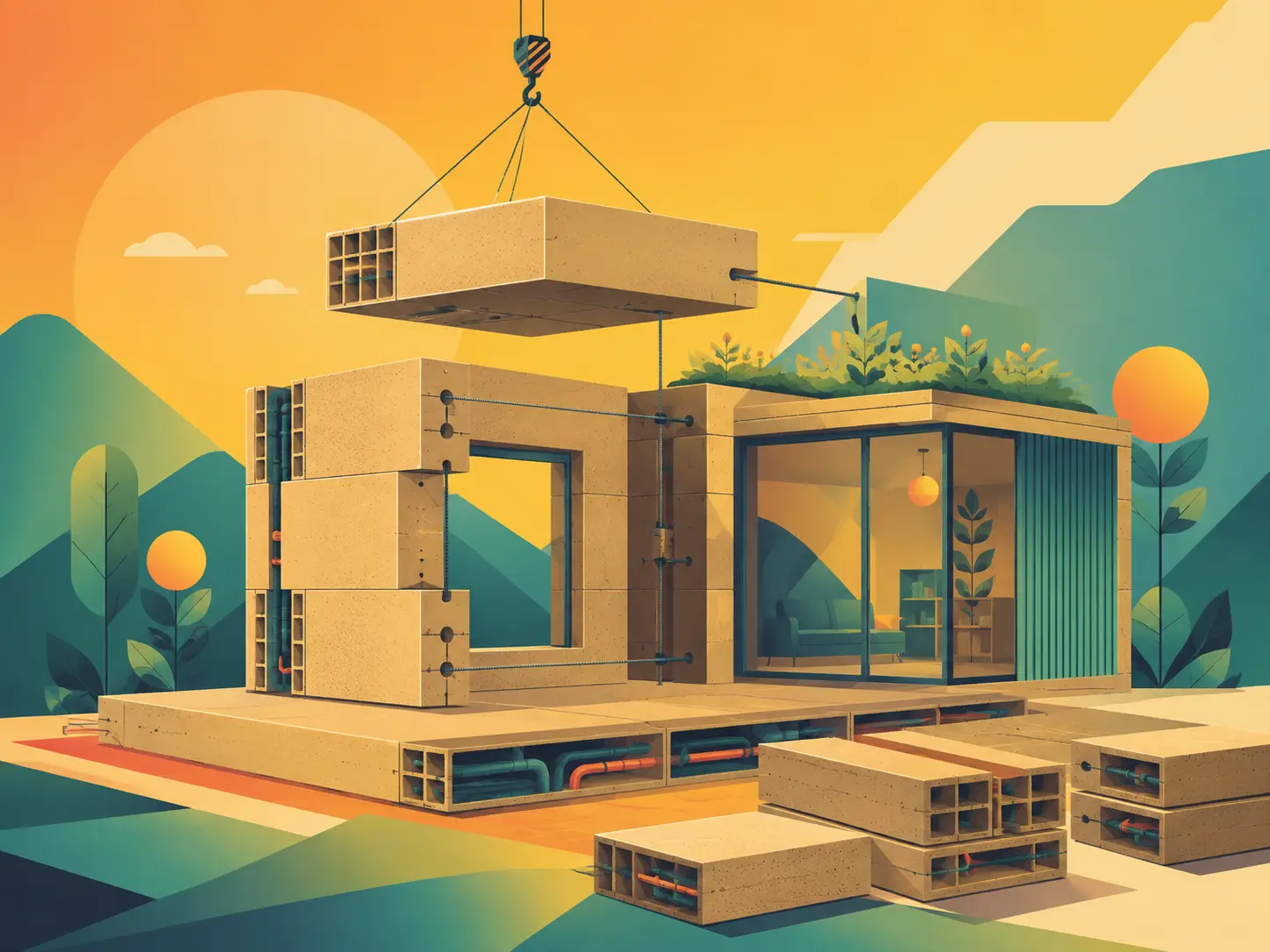
We are exploring stackable blocks made from lignocellulosic materials such as engineered wood, bamboo, hemp or other plant-derived feedstocks, with geometry designed around their particular advantages.
How it works
A clear principle.
A system to test.
Separate the functions of material, services and reinforcement—then reconnect them as a repeatable system.
- 01
Stack
Prefabricated blocks register with one another through a repeatable assembly process.
- 02
Route
Internal passages create pathways for building services or structural elements.
- 03
Reinforce
Vertical or horizontal reinforcement connects components into a larger system.
Evidencethrough action.
What we have investigated
An early concept designed to meet decisive tests
Bamblock remains an early-stage technology concept. We are not presenting it as a finished building system.
Our work is to test the assumptions that matter: material behaviour, connections, structure, moisture, fire, durability, manufacturability and construction workflow.
Where this could lead
Potential, conditional on the evidence.
These are possible applications and outcomes—not demonstrated results.
- Greater use of renewable or biogenic materials
- Potentially lower embodied carbon with rigorous life-cycle evidence
- Adaptable regional manufacturing and simplified assembly
- Resilient, affordable or rapidly deployable housing
Current focus